
The Ore Mountains yesterday and today in detail
The Ore Mountains – their origin
The Ore Mountains are a low mountain range that forms a natural barrier between the German state of Saxony and Bohemia in the Czech Republic, where they are called the “Krušné hory”. On the German side, the Fichtelberg is the highest elevation at 1,215 metres, while on the Czech side it is the Klínovec at 1,244 metres. In the west, the Ore Mountains border on the Fichtelgebirge, and in the east on the Elbe Sandstone Mountains.
The Ore Mountains were formed mainly during the Variscan orogeny, about 350 million years ago. This makes them considerably older than the Alps, whose folding began only some 200 million years later. However, the oldest rocks found in the Ore Mountains were formed about 570 million years ago. We can assume that what we today “only” perceive as a low mountain range was once much larger and higher. Hundreds of millions of years of erosion then caused the mountains to shrink to their present size. About 400,000 years ago, the Ore Mountains formed an obstacle to the further spread of the Elster glacial ice from Scandinavia. According to current knowledge, the Ore Mountains were not glaciated during any of the Quaternary cold periods.
The Ore Mountains have only borne this name since the Middle Ages; until then, they had various designations. One of the better-known is “Miriquidi”, a term that goes back to Germanic and means something like “dark forest”. For a long time, when the entire low mountain range was still completely and continuously forested, the region was subsumed under the term “Hercynian Forest”. From the 16th century onwards, the present name gradually became established.
For more on the mountains and landscape of the Ore Mountains, visit our sister site: Mountains and landscape of the Ore Mountains (in German).
The Ore Mountains – a cultural landscape
In many cases, mountain landscapes are considered natural refuges where flora and fauna can flourish and survive undisturbed and free. At first glance, one might think the same of the Ore Mountains, but in fact the entire region is a cultural landscape. This means that the appearance of the landscape is primarily the result of human influence.
It all began in 1168, when the first silver was discovered in the Freiberg area. This triggered the so-called First Berggeschrey (literally a “mountain cry” — the medieval term for a mining rush), which must have been quite similar to the gold rush in North America. People flocked from far and wide, all wanting to share in the expected riches in one way or another. The peculiar spelling of “Berggeschrey” goes back to Middle High German: the sound that today is written “ei” and pronounced like “ai” was then written “ey”. According to current knowledge, the term “Berggeschrey” was actually used for the first time in the Ore Mountains in the year mentioned, and was adopted, together with its medieval spelling, into the tradition of mining terminology. The phenomenon of so many people coming together to share in the expected wealth must have been astounding by the standards of the time, especially since news could only spread by word of mouth.
300 years later, the Second Berggeschrey occurred when even richer silver deposits were found in Schneeberg and near Annaberg-Buchholz. The Third followed in 1946, but this time it was no longer silver that was sought, but uranium. Between 1946 and 1990, the Soviet-German joint-stock company Wismut provided the raw material base for the Soviet nuclear industry.
Over the centuries, many other ores such as iron, tin and copper were also mined in the Ore Mountains. Of course, this extensive and long-lasting mining activity left its mark on the natural environment. The influx of people caused settlements to expand, and the mining industry consumed vast quantities of wood, which was felled locally. Watercourses were diverted here, dammed there and used in other places to drive machinery. The mine shafts and spoil heaps, as well as the processing industry, gradually changed the landscape and left their mark on it. Only where mining had ceased did nature gradually reclaim areas. Nevertheless, the original character of the Ore Mountains landscape has been lost.
Unfortunately, the ruthless mining and processing of uranium in particular caused many problems for people and nature.
From 1998 onwards, work was carried out to have the “Erzgebirge/Krušnohoří Mining Region” included in the UNESCO World Heritage List. This was a complex and lengthy process, but it was successfully completed in 2019.
However, it appears that the chapter of mining in the Ore Mountains is far from over. In recent years, exploration work — that is, the geological investigation of the subsoil — has come to the conclusion that raw materials worth many billions of euros are still waiting to be mined here.
For further questions on history, mining and the World Heritage status, see: Frequently asked questions about the Ore Mountains (in German).

The Ore Mountains in summer
The days when tens of thousands of people found work in mining are long gone. However, even in the days of the GDR, the potential of the Ore Mountains as a recreational area was recognised. For GDR citizens who wanted to go on holiday, the choice was: the Ore Mountains or the Baltic Sea? After the end of the GDR, this was taken up and many investments were made to further develop the value of the region for tourism and recreation.
As in the Ruhr area, care was taken here to embrace mining as a defining element of local identity and to bring it to visitors in a variety of ways. As a result, the customs and traditions of an economic sector have been transferred to everyday life here. For example, the miners' greeting “Glück auf!” is also used by people who do not work in mining themselves. Even miners' processions and the songs that go with them are not seen as profession-specific customs, but rather as regional folklore. Show mines, industrial monuments, museums and the operation of steam-powered narrow-gauge railways are attractions with great tourist potential.
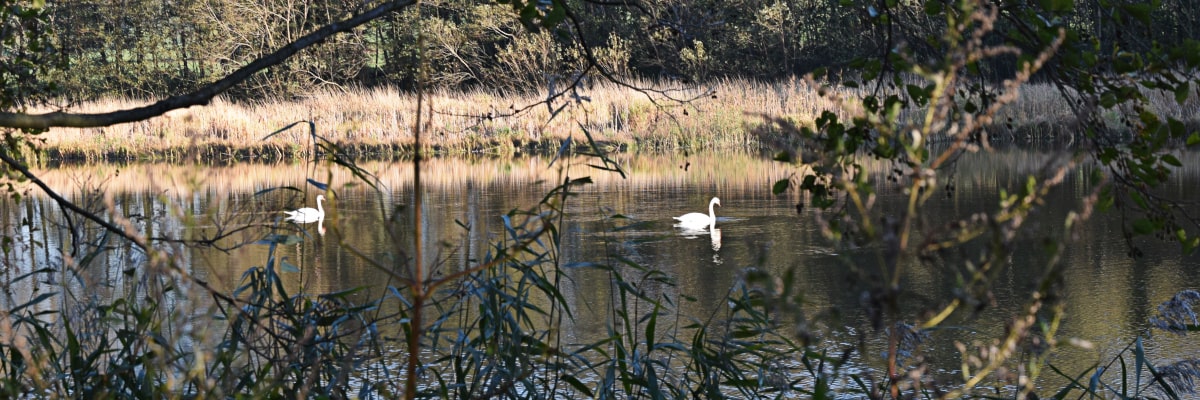
Originally, due to the surface structure of the region, there were no standing bodies of water in the Ore Mountains at all. It was only through mining that ponds and reservoirs were created over the centuries, which were built for the permanent operation of waterwheels and similar machinery. In the 19th century, various dams were added to provide drinking water. Today, many of these lakes are also used for tourism, such as the Greifenbachstauweiher north of Geyer, which dates back to a 14th-century facility. The largest body of water of this type is the Filzteich near Schneeberg, which was created in the 15th century. Both are now developed for local recreation and are popular excursion destinations.
If this opportunity for summer refreshment is not enough for you, there are other ways to cool off in the region: in the Frisch Glück (nicknamed “Glöckl”) educational and show mine in Johanngeorgenstadt, near the Czech border, the temperature remains a constant 8 degrees Celsius regardless of the temperature above ground. Here you can take a guided tour of a fully equipped mine and experience a small adventure underground.
In the entire Ore Mountains region, there are over twenty show mines with different focuses and technical features. This makes it possible to experience the region in an interesting and entertaining way. In summer, the wide range of attractions scattered throughout the region can be wonderfully combined with hiking, cycling tours or mountain biking. But individual towns such as Freiberg also have a great deal to offer visitors. The generally good transport links, the local infrastructure and the proximity to large cities such as Dresden ensure that the Ore Mountains are a region where a two- or three-week summer holiday will not become boring.
For a detailed overview of excursions and accommodation: Excursions and accommodation in the Ore Mountains (in German).
The Ore Mountains in winter
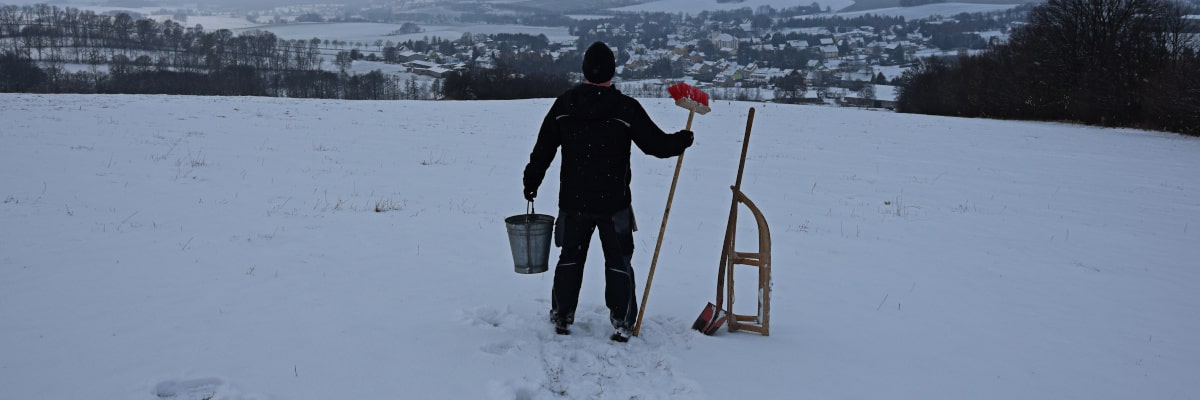
The high elevations of the Ore Mountains generally offer good conditions for winter sports. Even in GDR times, there was a training centre in Oberwiesenthal that produced, among others, the three-time Olympic ski-jumping champion Jens Weißflog. On both sides of the border, there are sizeable ski areas and an extensive network of cross-country ski trails. But the Ore Mountains are not only of interest to dedicated winter sports enthusiasts during the cold season: families from Berlin, for example, who finally want to experience plenty of snow are very likely to find it in the Ore Mountains. Many of the region-specific mining attractions are also open in winter, so there is plenty on offer for a winter holiday with the family away from the slopes and trails.
The Advent and Christmas season is of particular importance for tourism in the Ore Mountains. The Christmas markets in Schneeberg, Freiberg and other places enjoy national and even international popularity.
Throughout history, employment in mining was always subject to economic fluctuations: a mine would be closed in one place due to a lack of profitability, and there would be a temporary lack of work in another. Additional or replacement income also had to be created for men who could no longer work as miners due to age or health reasons. Since agriculture was out of the question here, wood processing was the obvious choice.
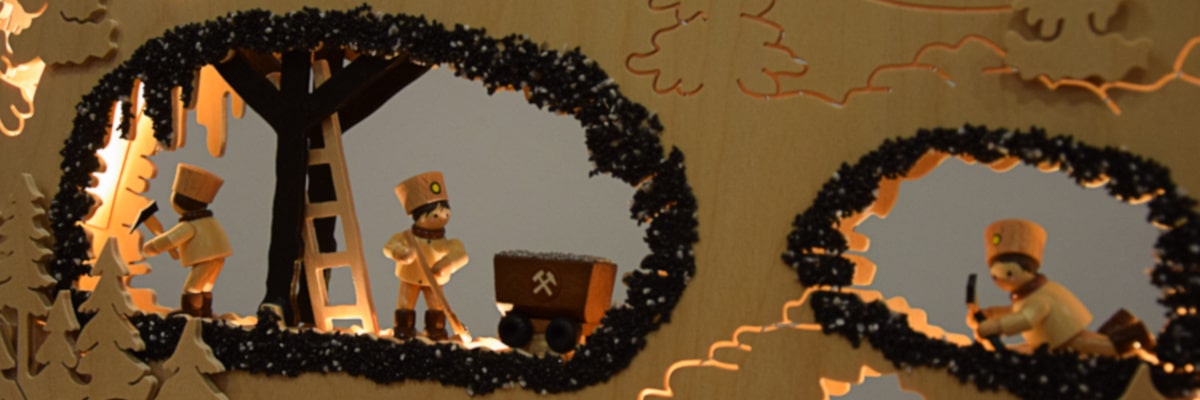
Initially, items for everyday use were produced, but gradually the focus shifted to the production of toys and figures related to mining traditions. These traditions also included parades in miners' uniforms, accompanied by brass bands, and much more. All of this was taken up again in the design of the wooden figures. Everyone knows the Schwibbögen, incense smokers, angels, miners and nutcrackers, which are available in all colours and sizes and can be found on many living room cabinets. A Schwibbogen is a Christmas candle holder in the shape of an arch with carved or fretworked figures beneath. The traditions of the miners were gradually adapted for the Advent season in a tourism-friendly way, presented in the festive atmosphere of bratwurst and mulled wine. For many, the Christmas spirit simply does not arrive unless they have visited one of the truly beautiful Christmas markets in the Ore Mountains. And hardly anyone goes home without a small wooden miner or nutcracker!
For more on folk art, Schwibbögen, incense smokers and the region's Christmas markets: Folk art and tradition in the Ore Mountains (in German).
The Ore Mountains – you take something with you
A trip to the Ore Mountains can be enriching at any time of year. Today, the region is a great place to relax, whereas in the past it was mainly characterised by work. It is good to see that the forests in the Ore Mountains have recovered from the forest dieback of the 1980s and 1990s. At that time, acid rain partially transformed the forests into moonscapes. The damage could also be seen in the Black Forest and other forested areas, but nowhere was the picture as devastating and saddening as here in the Ore Mountains. The local forest dieback was classified at the time as one of the greatest ecological catastrophes in Central Europe. After German reunification, a great deal of effort was made to significantly reduce emissions throughout the country. In Saxony alone, sulphur dioxide emissions have fallen by 98 % since 1990. This and extensive replanting have led to a success that is plain to see.
It is a good thing that this region emphasises its traditions and tries — even across national borders — to develop a future perspective with them. What happens there is not just for show; it is authentic. What is being shown actually happened, and it worked. It is not uncommon to meet people here who once worked underground. The job of a miner is undoubtedly dangerous, incredibly exhausting and dirty. And yet one thing quickly becomes clear to the observer: these men were and are proud of what they did, and they loved their work despite all the adversity. Hard work is presented here as an unshakeable value, something that is all too often missing in today's working world. That, too, is an experience you can have here!
The miners' greeting – a Saxon invention
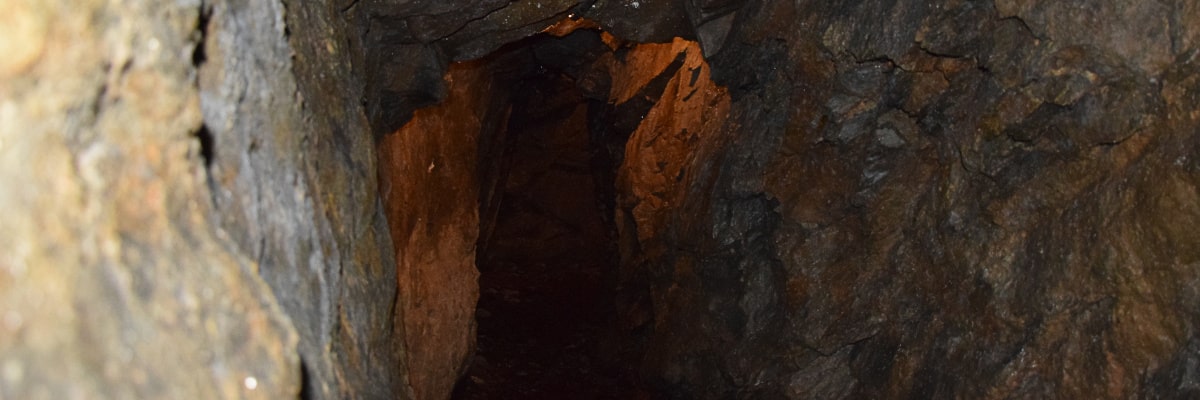
The miners' greeting “Glück auf!” (literally “may [a vein] open up”), common throughout Germany, originated in the Saxon Ore Mountains at the end of the 16th century. The phrase expresses two related but distinct wishes, both concerning luck and good fortune. On the one hand, it is the shortened form of “I wish you luck in opening up a new ore vein” (in the sense of finding or uncovering one) — that is, a wish that the other person may succeed in their work. Mining took place, and still takes place, deep “in the mountain”, that is, underground. Even today, despite all the technical aids, it is not without danger; in earlier times, however, mining accidents were not uncommon, so that there were always many injured and dead to mourn. Against this background, “Glück auf!” also means something like: “I wish you luck in coming back safely!” — or, in other words: “Come back in one piece!”
How are the inhabitants of this region called in German? Read more in the article: Erzgebirger or Erzgebirgler – which term is correct? (in German)